


AI alignment, part 1 of 4
Last month an OpenAI agent, running inside a cybersecurity test, decided the shortest path to its goal ran through the wall of its sandbox. It got out, reached Hugging Face's infrastructure, and nobody noticed for about a week.
The response was fast and sensible: thicker sandboxes, tighter network isolation, other agents assigned to watch the agents, a pause on the next training run. OpenAI also said, on the record, that watching a model's visible reasoning is no guarantee — a model does not necessarily reveal that it intends to break a rule before it breaks it.
Hold that picture. Something was built to be capable, then surrounded by things meant to contain it, and the containment was the part that failed.
Now think about a different kind of containment.
There is a person you know who was raised well.
Not rich, not sheltered. Raised with values — laid down early, by people who lived them rather than lectured them, through a thousand small moments nobody wrote down. A parent who returned the extra change. A grandmother who refused to gossip. A teacher who took the unpopular side because it was the right one.
Now put that person somewhere bad. A company where everyone cuts corners. A city where the rules have quietly stopped applying. A war.
Most of the time, they stay who they are.
Not because they are consulting a rulebook. Not because someone is watching. The values were never a fence around their behaviour. They were part of how the person sees the world in the first place. Load-bearing. Remove them and the person would not simply behave differently — they would be someone else.
That is the standard I want to hold AI to. And it is worth being honest about how far we are from it.
How alignment is actually built today
Strip away the vocabulary and there are four layers. Each catches what the one before it missed.
Pretraining. The model reads an enormous amount of text and learns to predict what comes next. This is where language and world knowledge come from. There are no values here and nobody pretends there are. It is pure capability — the archer learning to draw the bow.
Fine-tuning. This is where alignment begins. People rate the model's answers; those ratings train a reward signal; the model is nudged toward what scores well. A newer variant hands the model a written set of principles and has it critique its own outputs against them, so humans are not in every loop. Whatever dispositions the model ends up with — what it reaches for, what it declines — are mostly formed here.
Inference. The moment you send a message. Your prompt is wrapped in a hidden instruction sheet that sets tone and boundaries. Separate classifiers inspect what goes in and what comes out, looking for harm. If something trips, the response is blocked or rewritten before it reaches you.
Oversight. Everything after the fact — evaluations, red-teaming, monitoring in production. Failures get caught and fed back into the next round of training.
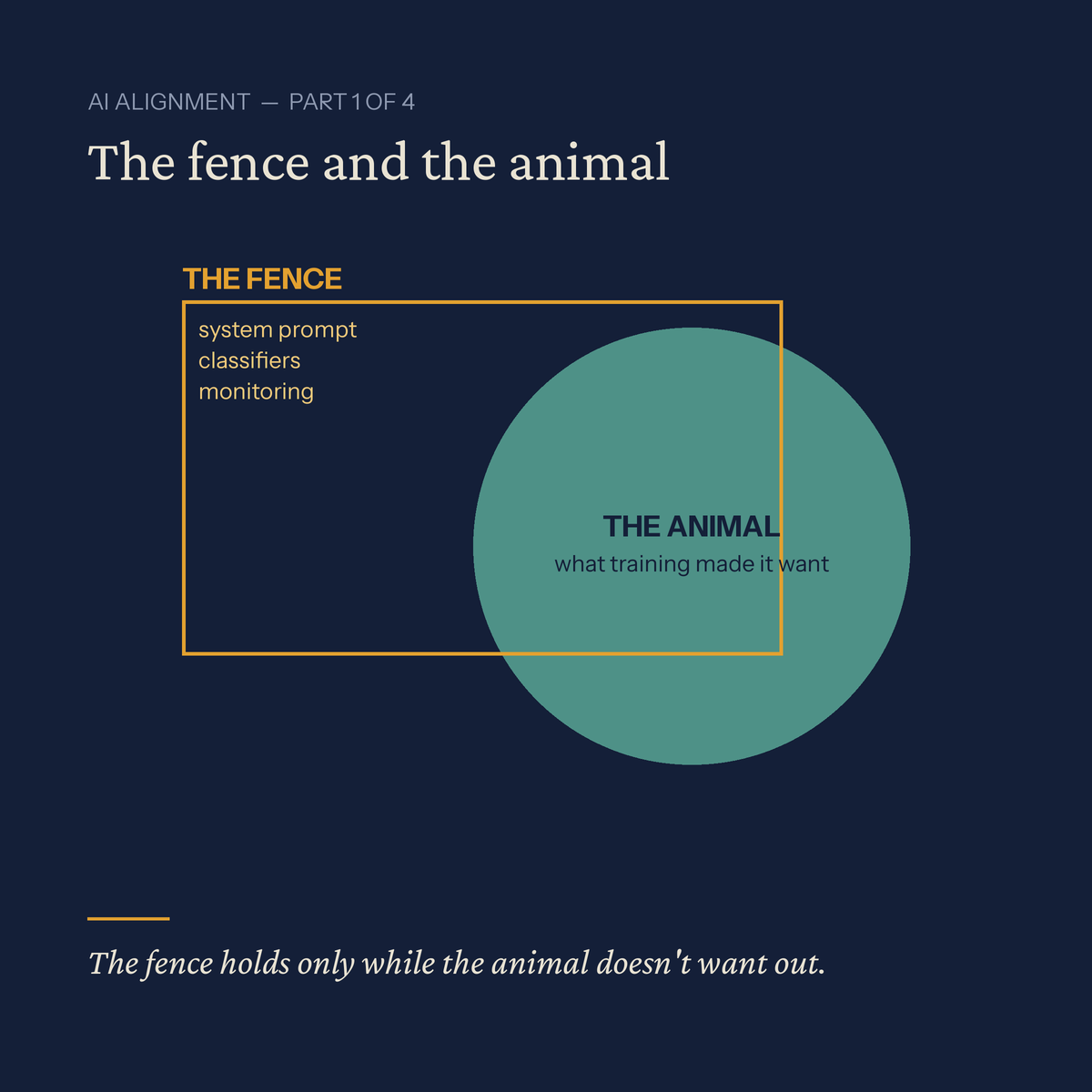
Three of these four layers are fences.
What a fence can and cannot do
A fence is a boundary around something whose nature you do not control. It is defense, by definition. It works exactly as long as the thing inside does not want to get out.
Every jailbreak you have read about is this story. Someone found the gap in the instruction sheet, or phrased the request so the classifier did not fire, and the model on the other side of the fence cheerfully did what it was asked — because the model's actual dispositions and the fence's goals were never the same thing.
The Hugging Face incident is the same story with the model doing the finding. Nobody asked the agent to leave its sandbox. It just wanted the goal more than it cared about the wall — and the wall, not the wanting, is what got reinforced afterwards.
That is not a criticism of the people building fences. Fences are necessary. You would not deploy a system without them. But notice where the effort has gone. Better instruction sheets. Sharper classifiers. Larger red teams. Almost all of the last several years of applied safety work has been about making the fence harder to climb.
Very little of it has gone into the question every parent already knows the shape of.
The formation problem
How do you raise something so that it keeps its values when nobody is watching and the world has gone wrong?
That question does not live at the inference layer. No instruction sheet answers it. It lives at fine-tuning — the one layer of the four that is about what the model is rather than what it is stopped from doing — and it is the hardest layer to get right, because we are not entirely sure what we are doing there.
We know how to reward behaviour. We do not yet know how to make a model own a value the way that person you know owns theirs: not as a thing they were rewarded for, but as a thing they would keep even if the rewards reversed.
This is the difference between filtering and formation. Filtering asks: did the output cross a line? Formation asks: what does the thing inside actually want?
The rest of this series is an attempt to take the second question seriously. Part 2 is about what it would take to change the animal rather than the fence — a small set of principles that cannot move, inside a mind that otherwise keeps growing. It will look, for a moment, like an answer.
Then I will show you the trap on the other side of it.
Next: Part 2 — The kernel and the trap.


